This year’s CBAA Conference in Nipaluna/Hobart featured two sessions about AI and technology:
- Practical AI for Community Radio - Tea Uglow (Business Advisor, AI & Emerging Tech, EP Australia)
- AI and Media: Opportunities, Challenges and Audience Trust – Dr Michael Davis (Research Fellow, University of Technology Sydney)
- The WA Tech Hub Showcase – Andrew Morris (Senior Manager, Technology & Digital Innovation, CBAA), Ben Menaglio (Technician), David Marshall (Harvey Community Radio)
Here are 6 key takeaways from these three sessions.
- Responsible use starts with clear transparency and consent
A recurring theme was the importance of station-level policies about how AI is used particularly around cloned voices, audience disclosure, and data security. Some stations already have internal guidelines stating that all broadcast voices must be human, while AI can be used “in the background” for admin and production efficiency. The key messages: have a policy, know who owns the tool, read the data settings, pay for secure versions where possible, and make sure audiences are informed when AI plays a visible role.
- Approach AI with a balanced mindset
Tea encouraged stations to engage with AI because while AI won’t change everything we do, it’ll change how we do everything. We’re in an interesting period of transition, so there is a need to engage with AI like we did when, for example, computers and the internet emerged. There is a responsibility as community broadcasters to understand AI and communicate about it accurately.
- Governance, collaboration and sector guidance are essential to managing risk
The session highlighted big structural issues: AI tools are often trained on news content without consent, chatbots can misattribute journalism, and deepfakes and “AI slop” make verification harder. In response, major media organisations are developing editorial guidelines, and there are emerging international charters and public-interest AI projects.
- AI is being used cautiously, with integrity and trust front of mind
Australian newsrooms and broadcasters have generally been slower to adopt generative AI than many of their global peers, mainly because of concerns about news quality and audience trust. Most organisations are avoiding fully AI-generated, audience-facing news content and insist on strong human oversight whenever AI is involved. For community broadcasters, that are hyperlocal and community-centred, it is important to proceed very carefully with audience facing use of AI and to prioritise protecting your editorial standards and audience trust.
- A shared technical model is transforming station resilience
The WA Tech Hub pilot, where eight stations across south-west WA share a technician, shows that a collaborative, shared engineering model can instil confidence, security, and more forward thinking when it comes to tech, and give stations access to consistent, skilled support they could not secure alone when it comes to costs.
- Collaboration is a positive side effect
While the stations oversee the project together as a committee and make decisions together, the other unexpected outcome is simply stronger relationships and knowledge-sharing between the eight stations, with volunteers even attending each others’ events and training sessions. Helping each other out has made the stations more resilient, and this collaborative environment is exactly in line with our Roadmap 2033’s strategic priorities.
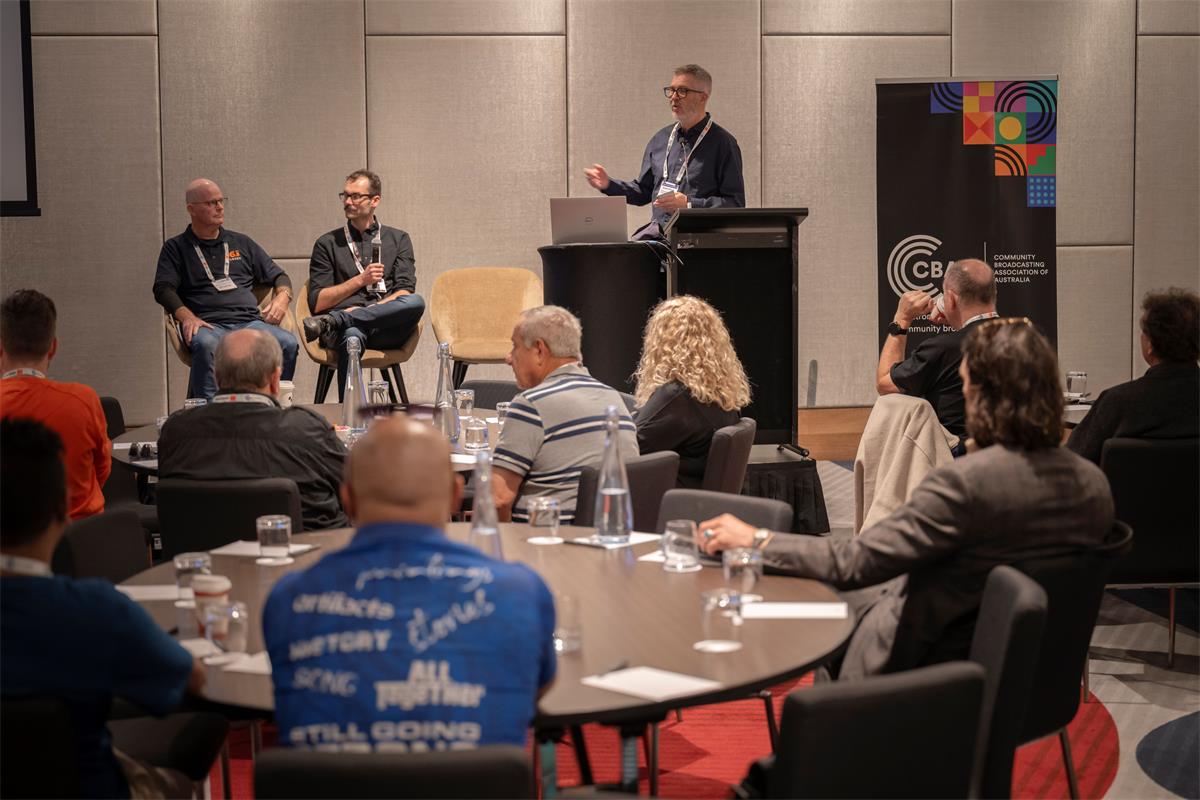 Andrew Morris
Next year’s CBAA Conference will be held in Geelong/Djilang 22-24 October 2026. Sign up to receive our communications to make sure you’re first to know when we release tickets.
This article has been prepared with the assistance of AI for transcription of presentation audio and summarising functions. The article has been reviewed by CBAA staff.